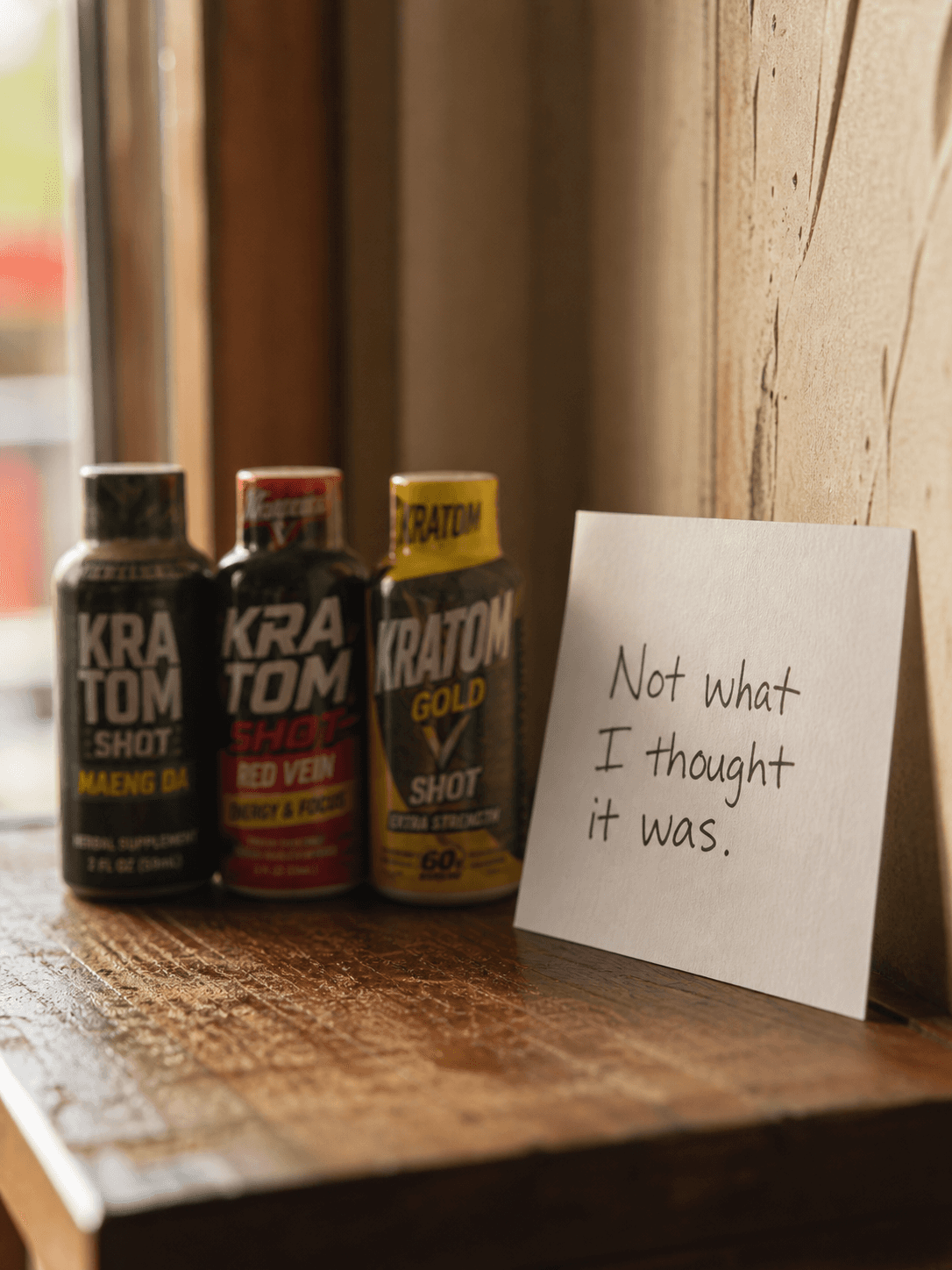
7-OH is more potent than most people realize. And it's in more products than you think.
7-hydroxymitragynine — the concentrated opioid-receptor compound in kratom extracts and shots — creates dependence that's harder to break than plain kratom. A trained recovery specialist checks in every week. Coverage may be available through insurance or Medicare.
In crisis? Call or text 988 anytime — free, confidential, 24/7.
more potent at opioid receptors than morphine
Estimated relative potency of 7-OHsevere withdrawal than plain kratom powder — closer to opioid withdrawal in intensity
Clinical case reports, FDA adverse eventsavailable in shots, gummies, and extracts — often without clear labeling
Sold in smoke shops, gas stations, onlineWhat is 7-OH — and why does it matter?
7-hydroxymitragynine is a minor alkaloid found naturally in kratom leaf in very small amounts. In natural powder it makes up less than 2% of alkaloid content. But it's been isolated and concentrated by supplement manufacturers, and now appears at much higher levels in many commercial products: shots, liquid extracts, gummies, capsules, and "full spectrum" kratom products.
It binds strongly to mu-opioid receptors — the same receptors that heroin and prescription painkillers act on. This is what drives kratom's pain-relieving, sedating effects at higher doses. And it's what drives dependence.
The key difference between plain kratom powder and 7-OH concentrated products: the potency is dramatically higher, dependence develops faster, tolerance escalates more quickly, and withdrawal is more intense when stopping.
If you've been using kratom shots, extracts, or gummies — rather than plain powder — you're likely using a product with concentrated 7-OH. The recovery approach may be different, and physician involvement in any plan to stop or reduce is strongly recommended.
Opioid receptor binding
7-OH binds to mu-opioid receptors with high affinity — the same mechanism as morphine and heroin. This is what produces opioid-like effects and drives physical dependence.
Dramatically more potent than powder
While plain kratom powder contains trace 7-OH, concentrated extract products may contain 10–100x more — without clear labeling of the actual concentration.
Tolerance escalates quickly
Because of its potency, tolerance to 7-OH products tends to develop faster than with plain kratom. Users often find they need more product more quickly to achieve the same effect.
FDA has flagged specific concerns
The FDA has taken enforcement actions against high-potency 7-OH products and has classified certain kratom compounds as Schedule I candidates. The regulatory status continues to evolve.
Where 7-OH shows up — and what the risk looks like.
Many people using 7-OH products don't know that's what they're taking. Here's what to look for.
Plain kratom powder
Natural leaf powder with trace 7-OH. Mitragynine is the primary active alkaloid. Still creates dependence with regular use — but withdrawal is typically less intense than concentrated products.
Kratom extracts and tinctures
"Full spectrum" extracts, enhanced powders, and tinctures. 7-OH concentration varies widely and is rarely disclosed on labels. Often sold as more potent or longer-lasting products.
7-OH shots, gummies, and tablets
Products specifically marketed as "7-OH" or "7-hydroxymitragynine." High potency, often fast-acting. Associated with more rapid tolerance escalation, more intense withdrawal, and higher overdose risk — especially with other substances.
Is it a dependency?
These are the signs most people describe when they realize 7-OH has become something they can't stop without help.

Someone who's been there.
"I've worked with people who didn't even know what 7-OH was — they just knew the shots had stopped working unless they took more. That's where we start: understanding what's actually in what you've been using, and what that means for what comes next."
Every specialist at Accountable has their own lived experience with recovery. You're matched with someone whose story actually rhymes with yours — not randomly assigned. The match is intentional.
How it works.
Mostly online. Most members are paired with their specialist within 24 hours.
Tell us about you.
Name, DOB, and insurance info if you have it. We check for coverage that may help pay — or set you up on a private-pay plan.
We match you with a specialist.
Someone whose story rhymes with yours. Substance, stage, situation — the match is intentional.
A short doctor visit (insurance coverage only).
If your insurance covers the service, a doctor sets up your care plan by phone or video — about 20 minutes. Private-pay members skip this step.
Your specialist starts showing up.
Every week by video call. Face-to-face, consistent, and on your schedule.
Accountability testing — required.
Accountability testing is a required part of working with Accountable — not because we don't trust you, but because verifiable sobriety is one of the most powerful tools in recovery. The structure is part of what makes this work.
Oral fluid testing only
We use oral fluid (saliva) tests only — no urine collection required. Testing is done at home using a saliva swab. Standard oral fluid panels detect kratom alkaloids including mitragynine. Results are reviewed by your specialist, and where required by your care plan, confirmed by a certified laboratory.
- At-home oral fluid testing — A saliva swab you complete at home and photograph. Reviewed by your specialist at your next check-in.
- Lab-confirmed oral fluid testing — The same swab sent to a certified lab. Tamper-resistant, medically defensible.
- Scheduled and random testing — Both types are part of your care plan. The combination matters.
What a positive result means
A positive result doesn't end your services. It's information — for you and your specialist — about where you are and what support you need next. Your specialist works through a positive result with you, not against you.
Testing is required, not optional. It's one of the things that makes Accountable different — and part of what makes the outcomes better.
Start today. No insurance required.
You don't need Medicare, private insurance, or a referral to get started. Accountable is available to anyone who wants consistent, weekly recovery support from a trained specialist.
Private pay — available to everyone
Plans start at $375/month for weekly specialist contact. No long-term commitment — start, pause, or stop at any time. Works for anyone under 65, people who prefer to keep insurance out of their recovery, or families paying for a loved one directly.
Have Medicare or insurance? It may cover the cost.
Medicare Part B may cover peer recovery support services for substance use disorder — including 7-OH dependence. If you're 65 or older, or have been on SSDI for 24+ months, you likely qualify. We check your coverage during intake and confirm in writing before anything begins.
Not sure what you have? We check during intake — no cost, no commitment. Sign up and we'll figure it out together.
Numbers that matter.
people we've walked this with
as many relapses within a year
vs. industry baselines, 5-year periodmembers would recommend us
Based on member surveys, 2020–2025What people ask first.
Open the ones that apply. Skip the rest.
You don't have to figure this out alone.
A weekly call with someone who's been there — no insurance required to start. Getting started takes about two minutes.
Live FreeAccountable Navigator provides peer recovery support services and is not a substitute for medical care, addiction treatment, or emergency services. If you or a loved one is in crisis, call or text 988 to reach the Suicide & Crisis Lifeline.
Accountable is an independent Medicare-enrolled provider of peer recovery support services billed under Medicare Part B. Accountable is not affiliated with, endorsed by, or sponsored by the federal Medicare program, the Centers for Medicare & Medicaid Services (CMS), or the Social Security Administration. Coverage, eligibility, and out-of-pocket costs depend on your specific Medicare plan. Clinical services are furnished by licensed physicians of our affiliated medical practice based on each member's individualized care plan.
Your information is protected under HIPAA and 42 CFR Part 2. We share information outside your care team only with your written consent. See our Notice of Privacy Practices for details.
Stay Connected. Stay Accountable.
Recovery is a journey—let’s walk it together.
Contact Us
© 2026 Accountable

Stay Connected. Stay Accountable.
Recovery is a journey—let’s walk it together.
Contact Us
© 2026 Accountable
Stay Connected. Stay Accountable.
Recovery is a journey—let’s walk it together.
Contact Us
© 2026 Accountable
Stay Connected. Stay Accountable.
Recovery is a journey—let’s walk it together.
Contact Us
© 2026 Accountable